- The Hot Startups
- Posts
- Bollywood's Beauty and Fashion Brand Empire: Successes and Failures
Bollywood's Beauty and Fashion Brand Empire: Successes and Failures
An analysis of celebrity equity ventures, D2C strategy, and operational execution in India's booming beauty and consumer goods market

Dhara Mandaliya
December 23, 2025 • Reading Time: 5 minutes
In India, an inflection point hit in late 2010s, when Bollywood's female A-listers did the math on their Instagram reach and realized they'd been dramatically underpricing their distribution power.
A single sponsored post could move products worth crores in hours. So why settle for a one-time endorsement fee when you could own a piece of the enterprise you're building?
The women leading this charge - Sonam Kapoor, Katrina Kaif, Alia Bhatt, Deepika Padukone, Kriti Sanon - are taking on entrepreneurial roles with products that are an extension of their identity.
Some of these ventures are genuinely threatening legacy incumbents. Others are learning the hard way that 50 million followers don't fix a broken unit economics model.
Let’s look at their journey!

Some of our recent stories:
Should you always listen to your users?
(How to maintain a balanced approach)Why Did Bluelearn Fail?
(Is ed-tech in India doomed?)“90% of Start-Ups Fail” - How True Is This?
(What you can do to increase chances of success)
When Celebrity Equity Actually Works
Katrina Kaif's Kay Beauty represents the gold standard for how this model should function. Launched in 2019 as a joint venture with Nykaa, the brand was a structural innovation.
Nykaa brought operational infrastructure, supply chain expertise, and crucially, shelf space on India's dominant beauty e-commerce platform.
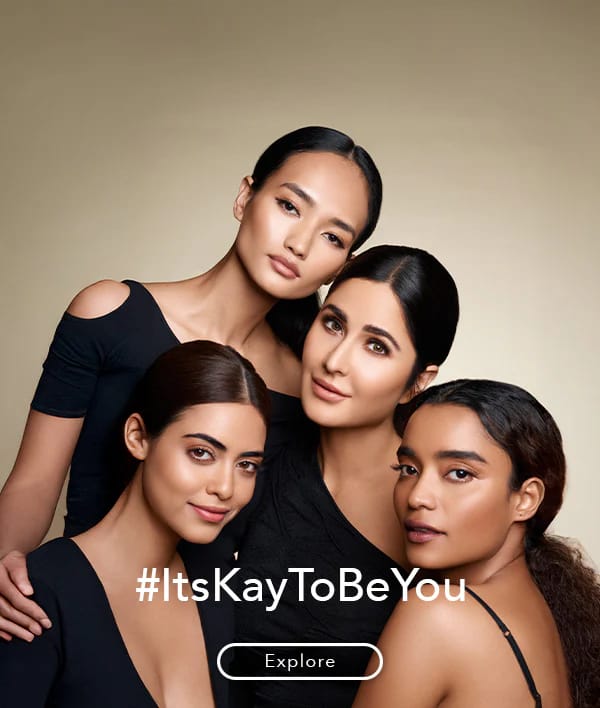
Katrina brought the ability to cut through noise in a crowded beauty market and build immediate trust with young Indian women navigating Western beauty standards.
The JV model worked because it created a safety net against the biggest risk in celebrity ventures - the launch-and-disappear phenomenon.
Too many celebrity brands generate massive first-month sales driven by curiosity and die quietly when the novelty wears off.
Kay Beauty avoided this trap because Nykaa's incentives were aligned with long-term category growth, not just maximizing Katrina's endorsement value.
The brand could afford to iterate on formulations, expand SKUs strategically, and build repeat purchase behavior without the pressure of immediate profitability that crushes standalone celebrity ventures.
By 2023, Kay Beauty had established genuine staying power.
The best celebrity founders understand they're building a distribution channel that happens to have a product attached to it.
Alia Bhatt's Ed-a-Mamma trajectory tells a different but equally instructive story.
Launched in 2020 with a sharp thesis - sustainable, toxin-free kids' wear in a market dominated by either cheap, synthetic fast fashion or prohibitively expensive imports - the brand identified a white space.
Indian millennial parents, particularly mothers, were actively searching for this exact positioning. Alia represented aspirational young motherhood for her demographic. When Reliance Retail acquired a 51% stake in 2023, it validated the fact that the brand had built real value beyond its founder's Instagram reach.

What made Ed-a-Mamma acquisition-worthy was that she'd identified a category gap. Urban Indian parents wanted the values (sustainable, chemical-free) without the Western price points or aesthetic. Reliance saw a scalable playbook for premiumizing India's kids' wear category through their retail network.
The partnership demonstrated that celebrity equity works when there's genuine product-market fit underneath the famous face.
The Incubator Model
The next evolution of the celebrity-founder playbook involves partnering with specialized incubators that handle everything celebrities typically can't - manufacturing, logistics, quality control, regulatory compliance.
Kriti Sanon's Hyphen, launched in 2023 in partnership with PEP Technologies, represents this "co-founder plus operational backbone" model. PEP (parent company of mCaffeine) is a skincare incubator that has already built infrastructure for formulation, testing, and scaling D2C beauty brands.
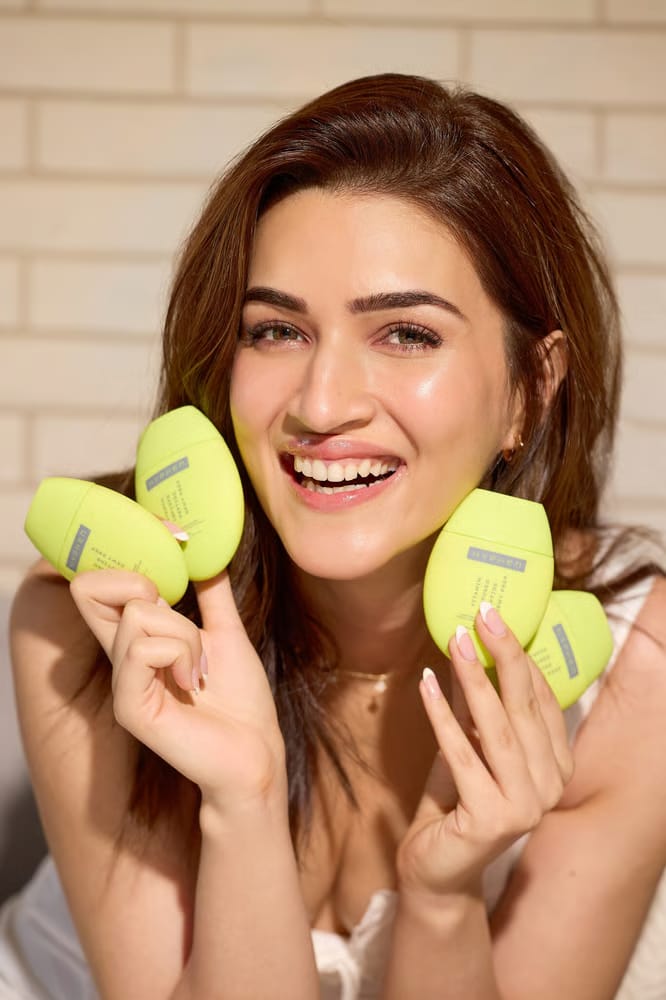
This structure effectively lets Kriti function as the ideal celebrity founder - focused on brand vision, content creation, and community engagement - while PEP handles supply chain complexity.
It's the entrepreneurial equivalent of bringing in a veteran COO to complement a visionary CEO.
The risk for Kriti is significantly lower than if she'd tried to bootstrap Hyphen independently, and PEP gains a distribution engine they couldn't build organically. Whether Hyphen develops into a category leader or remains a mid-sized player will depend on factors beyond initial launch hype - formulation quality, customer service, retention rates - but the structural setup at least gives it a fighting chance.
Deepika Padukone's 82°E takes a different tactical approach within the same strategic framework.
The brand adopted a luxury positioning unusual for celebrity D2C ventures in India - serums priced at ₹3,000 and above, clinical formulations, sophisticated minimalist packaging - betting that India's luxury skincare market had room for a homegrown challenger to international prestige brands.
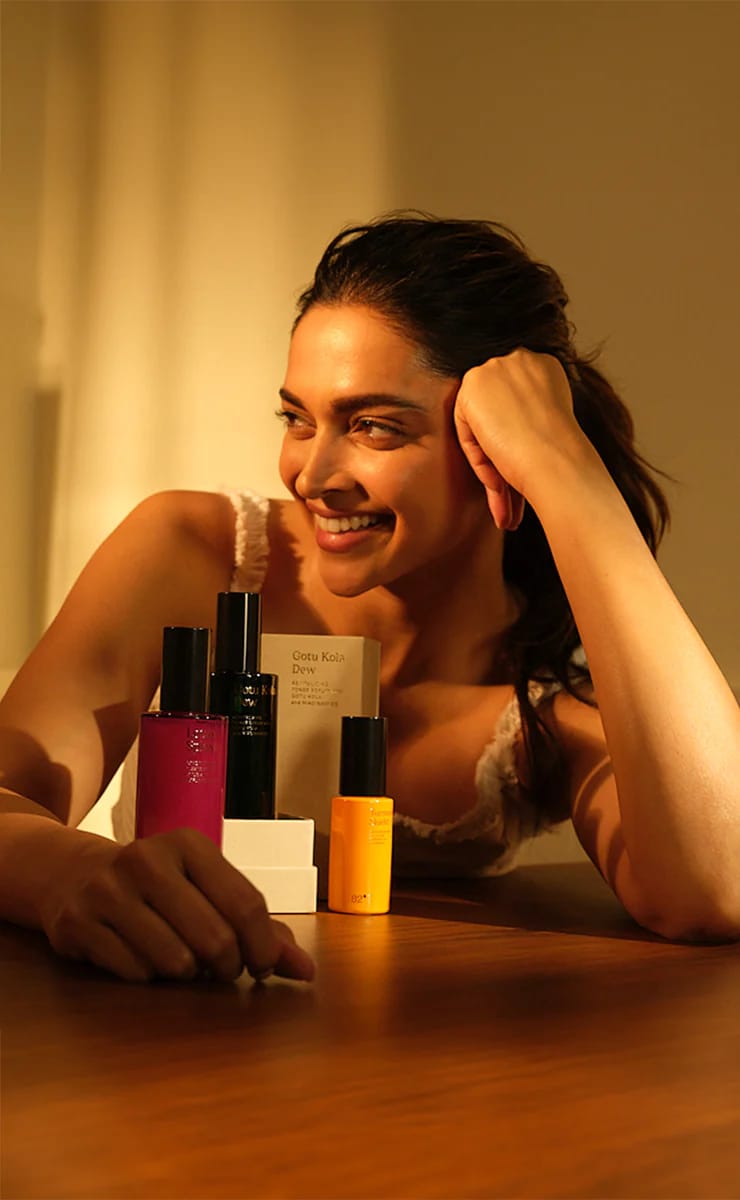
India's skincare market is notoriously price-sensitive, and even affluent consumers often balk at paying international luxury prices for domestic brands.
Deepika's global profile gives 82°E aspirational credibility, but translating that into sustained purchase behavior at premium price points is the operational challenge. So far, when it comes to celeb-led beauty and skincare brands in India, Kay Beauty and Hyphen take precedence over 82°E.
When Distribution Can't Save Bad Operations
Not every celebrity equity play works, and the failures are more instructive than the successes. Sonam and Rhea Kapoor's Rheson, launched in 2017 with Shoppers Stop, and Anushka Sharma's Nush, launched in 2021, both struggled to gain traction despite their founders' considerable star power and genuine fashion credibility.
Rheson's challenge was partly structural. The licensing model with Shoppers Stop meant the Kapoors had limited control over critical variables - inventory management, pricing strategy, retail placement, customer experience. When products didn't sell through, they couldn't pivot quickly. They were dependent on a legacy retail partner whose incentives weren't perfectly aligned with building a celebrity fashion brand.
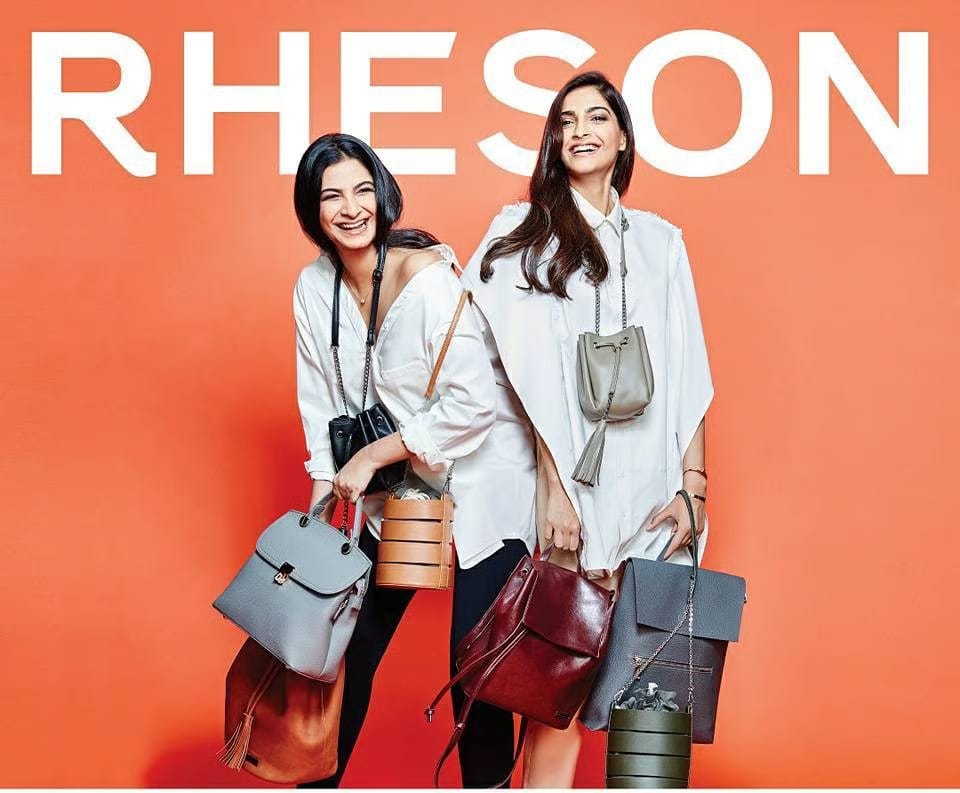
The collection also faced the fundamental challenge that plagues most celebrity fashion lines: replicating a celebrity's personal style (which is often expensive, niche, and trend-forward) at mass-market price points creates a cognitive dissonance. The customer who loves Sonam's fashion-forward aesthetic often can't afford it, and the customer who can afford it may not want watered-down celebrity style.
Nush encountered different but related problems. Anushka positioned the brand around "easy, comfortable everyday wear." The thesis was reasonable, but execution faltered.
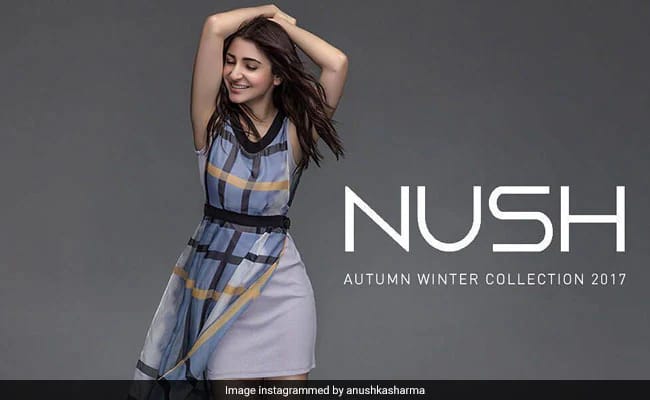
Fashion is brutally unforgiving on fundamentals: fabric quality, fit consistency, delivery timelines, return processing. One bad batch, one sizing discrepancy viral on social media, and customer trust evaporates. Additionally, Nush also faced plagiarism accusations with their designs, and had to remove those items from the collection, tarnishing trust and authenticity.
Fame gets you the first sale. Operations get you the second. And the second sale is where actual businesses are built.
These stumbles highlight a crucial lesson: beauty and personal care products have inherent advantages for celebrity ventures that fashion and apparel don't. Formulation can be outsourced to competent manufacturers. Quality control is more straightforward. Returns are lower. Inventory risk is more manageable because sizes and fits aren't variables. Fashion requires operational excellence across more dimensions simultaneously, and most celebrities lack either the expertise or the patience for that grind.
The Competitive Landscape
Are these celebrity ventures actually stealing market share, or just expanding the overall category?
The answer is probably both, but not evenly distributed.
Kay Beauty and 82°E are legitimately pulling customers away from international prestige brands by offering comparable quality at slightly lower price points with culturally relevant marketing.
But these celebrity brands also face threats from a different direction - the D2C insurgents like Mamaearth, Sugar, and Plum that cracked distribution and digital marketing before celebrities entered the arena. These brands spent years building supply chains, learning e-commerce logistics, and optimizing CAC before celebrity competition arrived.
Sugar, for instance, has unit economics and retail distribution that most celebrity ventures are still figuring out.
The celebrity advantage (instant awareness, built-in trust) matters less when the non-celebrity D2C brand already has distribution through Nykaa, Amazon, and thousands of retail touchpoints.
The legacy incumbents - L'Oréal, Hindustan Unilever, Lakmé - face a different calculus. They have distribution and supply chain excellence that celebrity startups can't match, but they're losing mindshare among young consumers who view them as their mothers' brands.
The celebrity ventures are better at cultural fluency, social-first marketing, and creating products that feel designed for contemporary Indian women rather than adapted from Western formulas. Whether that cultural edge translates into sustained business advantage depends on whether these celebrity founders can build operational capabilities before the incumbents figure out cultural relevance.
Key Insights:
Distribution First
The real edge is access to attention and customers, so build a repeatable distribution engine before obsessing over products.Borrow Expertise
The best founders admit what they don’t know and partner with people who’ve actually built and scaled consumer brands.Operational Rigor
Without fame as a safety net, non-celebrity founders need stronger systems to survive early mistakes and earn retention.Smart Markets
Beauty works because it balances margins, brand differentiation, and manageable operations, unlike fashion or food.Long-Term Game
Early hype only buys time; real businesses are built by staying involved and turning distribution into durable operations.
P.S. It would mean the world to us if you could reply to this and let us know how you liked it!

Reply