- The Hot Startups
- Posts
- How Prasuma Created India’s Frozen Momo Category and Landed ITC’s ₹131 Cr Acquisition
How Prasuma Created India’s Frozen Momo Category and Landed ITC’s ₹131 Cr Acquisition
Category creation, manufacturing moats, and perfect timing with quick commerce.

Dhara Mandaliya
December 30, 2025 • Reading Time: 4 minutes
In 1990, Mahendra Suwal travelled to Italy where he watched Italian grandmothers buying frozen ravioli from supermarkets - perfectly preserved dumplings that tasted as good as fresh.
Three decades later, it would become the foundation for Prasuma, an extension of the family’s deli meat business into a frozen momo brand that both created a category and secured one of India's most strategic food acquisitions.
ITC acquired a 43.8% stake in Prasuma for approximately ₹131 crore in February 2025, with plans to acquire 100% ownership by June 2028.
Prasuma had scaled to a ₹200 crore annual revenue run rate by selling something to Indian consumers for the first time: frozen ethnic food.
Look at the 'trade-off' the customer is making. In Prasuma Momo's case, customers were trading hygiene for taste. The startup that breaks this trade-off (giving both hygiene AND taste) created the market.
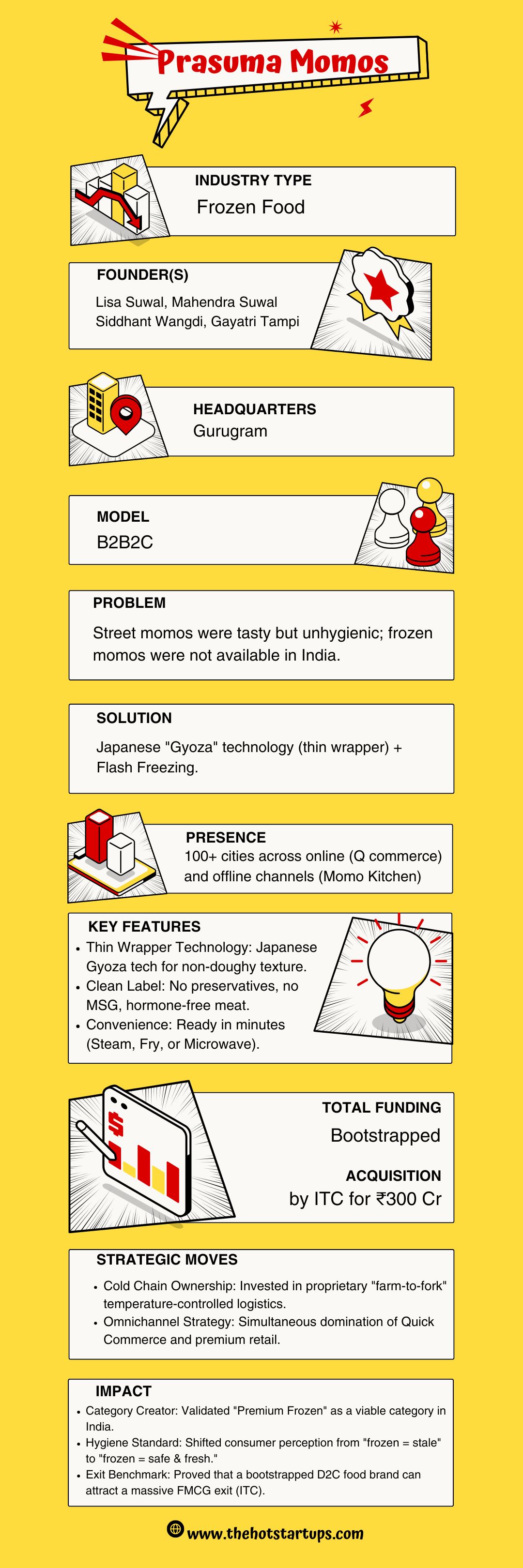
Here’s everything you need to know about the startup Prasuma Momos at a glance:
Some of our recent stories:
Building a ₹167 Cr Sneaker brand in 2 years
(The success of Comet Shoes)Bollywood’s beauty and fashion empires
(Successes and Failures)Where Amazon and Flipkart failed
(Meesho’s business strategy)
Let’s look at Prasuma’s start-up journey!

The Problem:
When Lisa Suwal officially joined her father's deli meat business in 2016 after stints at L'Oréal, she faced a fundamental challenge.
Indians prefer fresh food, with a stigma of “unhealthy” around frozen items, making it difficult to market them.
Growing up in Darjeeling and Nepal, momos were always central to family gatherings for Lisa. She wanted to bring her family recipes and perfect them into frozen food.
But street vendors sold fresh momos at every corner for ₹20. Why would anyone pay premium prices for frozen dumplings that required defrosting and cooking?
The answer wasn't obvious in 2016. But by 2019, the pieces were falling into place. Online grocery was gaining traction. Food delivery had normalized convenience.
And most critically, consumers were beginning to opt for frozen food with the pandemic lockdown, increased adaptation of work from home demanding further convenience, and rising influence of western habits.
The Solution:
Prasuma launched India's first preservative-free frozen momo in 2019, designed to be prepared in minutes. But creating the category demanded manufacturing precision.
The company fundamentally re-engineered the manufacturing process. Suwal introduced Japanese Gyoza technology to India. It allowed them to produce an ultra-thin wrapper that could withstand the freezing process without cracking or becoming soggy upon steaming.
They combined this technical advantage with a "clean label" marketing strategy by plastering "No Preservatives," "No MSG," and "Hormone-Free" on the packaging.
The strategy allowed them to compete with restaurants on convenience and quality. Prasuma's pricing positioned them higher than street vendors but lower than home delivery from restaurants.
Initial Challenges:
With category creation, the biggest challenge is selling the idea to retail, according to Gayatri Tampi, Prasuma's CMO.
Retailers didn't have frozen momo sections. Consumers didn't search for them. And most critically, trial was nearly impossible in a pre-pandemic world where sampling mattered.
The brand leaned heavily into digital marketing via social media, D2C platforms like BigBasket, and quick commerce like Blinkit and Instamart, targeting urban working consumers who valued convenience.
Distribution followed demand rather than creating it. Prasuma expanded from Delhi-NCR through word-of-mouth, entering new cities only when demand emerged organically. Requests would flood in and Prasuma would enter that market.
By 2021, the brand had reached 2,500 stores across 70 cities with a 92% repeat customer rate. The product-market fit was undeniable.
Quick Commerce Catalyst:
Between 2021 and 2025, quick commerce platforms - Blinkit, Zepto, Swiggy Instamart - exploded.
For frozen foods, this was transformative. Traditional retail required significant shelf space commitments and slow inventory turns. Quick commerce dark stores optimized for high-velocity items. A product that could be delivered in 10 minutes suddenly made freezers as accessible as refrigerators.
Prasuma products became available on these with 10-minute delivery, which helped to reach more people both organically and via paid campaigns.
The company partnered with ting for digital marketing on quick commerce, leading to 158% ROAS on Swiggy, spotlight ads on Blinkit, and 81% organic sales.
Prasuma Momo Kitchen:
Prasuma made a calculated move into hot food delivery. Launching Momo Kitchen cloud kitchens in early 2022, the brand aimed to mark its offline presence and offer access across all consumption occasions.
The economics worked surprisingly well. Each cloud kitchen grew 30% month-on-month, registering 100 orders daily within three months of launch.
Customers could choose fillings (vegetables, chicken, mutton, cheese), cooking styles (steamed, crispy fried, authentic gyoza), and gourmet sauces.
In 2024, Prasuma Momo Kitchen won three Swiggy Restaurant Awards - Best in Pan-Asian in Faridabad, Best in Momos in Noida and Gurugram.
The cloud kitchen strategy created a counterintuitive flywheel: delivery customers discovered the brand, then bought frozen products from retail, reinforcing loyalty across channels.
ITC Acquisition:
Prasuma stayed relatively capital-efficient through bootstrapping.
The multi-brand strategy helped. Beyond flagship frozen momos, Prasuma operated Meatigo (a D2C fresh meat platform) and Prasuma Momo Kitchen. Their product portfolio expanded to 170+ SKUs across momos, baos, Korean fried chicken, and delicatessens.
But why did ITC acquire it?
The strategic logic runs deeper.
ITC launched ITC Master Chef frozen snacks in 2019, offering products like nuggets and fries across towns. Despite FMCG expertise, ITC struggled to crack ethnic frozen foods.
Prasuma brought three assets ITC couldn't easily build: authentic recipes perfected over years, established distribution across quick commerce platforms, and consumer trust in a category they'd pioneered.
The rise of competitors like BluePine Foods, Wow! Momo’s frozen segment, Sumeru, and BoxBite also confirmed that the category is in demand and would remain profitable in the coming years.
ITC thus aims to become a comprehensive player in the ₹10,000 crore frozen, chilled, and ready-to-cook foods industry by leveraging synergies between Master Chef and Prasuma.
What's Next:
The Prasuma acquisition signals that FMCG giants recognize that ethnic frozen foods are no longer niche. Quick commerce made them mainstream.
Regional food brands with strong manufacturing and authentic recipes become attractive targets. The playbook is: perfect the product, ride quick commerce distribution, create customer loyalty through repeat purchases, then either scale independently or exit to a strategic buyer.
With frozen vegetable snacks accounting for the largest market share in a ₹593 billion projected market by 2033, there's room for multiple winners.
The question for founders: Can you create a category that quick commerce platforms need, build manufacturing excellence that's defensible, and execute fast enough to capture market share before giants wake up?
Prasuma answered yes. The ₹131 crore check from ITC proves it.
Key Insights:
Category Creation Requires Manufacturing Moats:
Anyone can freeze momos. Manufacturing process creates differentiation that's hard to replicate at scale.
Follow Consumer Demand Signals:
Prasuma entered new cities only when organic demand emerged through word-of-mouth, avoiding costly market creation expenses.
Multi-Brand Strategy De-Risks:
Cloud kitchens, D2C meat platforms, and frozen foods created revenue diversification while leveraging shared infrastructure.

Reply