- The Hot Startups
- Posts
- Recode Studios Business Strategy: The Anti-VC Beauty Brand Winning India's Tier 2 & 3 Cities
Recode Studios Business Strategy: The Anti-VC Beauty Brand Winning India's Tier 2 & 3 Cities
Building a Capital-Efficient Beauty Startup in India's Crowded Market

Dhara Mandaliya
January 20, 2026 • Reading Time: 4 minutes
The Indian beauty market is notoriously crowded. At the top end, you have legacy international giants like MAC and Estée Lauder, whose pricing is prohibitive for the vast majority of the population.
At the bottom end, unorganized local markets are flooded with cheap, often counterfeit products of dubious quality.
In the middle, a new wave of VC-backed D2C brands emerged around the late 2010s, mostly targeting the urban, digital-native consumer in metros like Mumbai, Delhi, and Bangalore (like Vineeta Singh’s Sugar)
There was a massive demographic that was being ignored: the aspirational consumer in Tier 2 and Tier 3 cities. These consumers had exposure to global beauty trends via Instagram but lacked access to reliable products at price points that made sense for their wallets.
So, Dheeraj Bansal and Rahul Sachdeva launched Recode Studios in 2018.
Here’s everything you need to know about Recode at a glance:
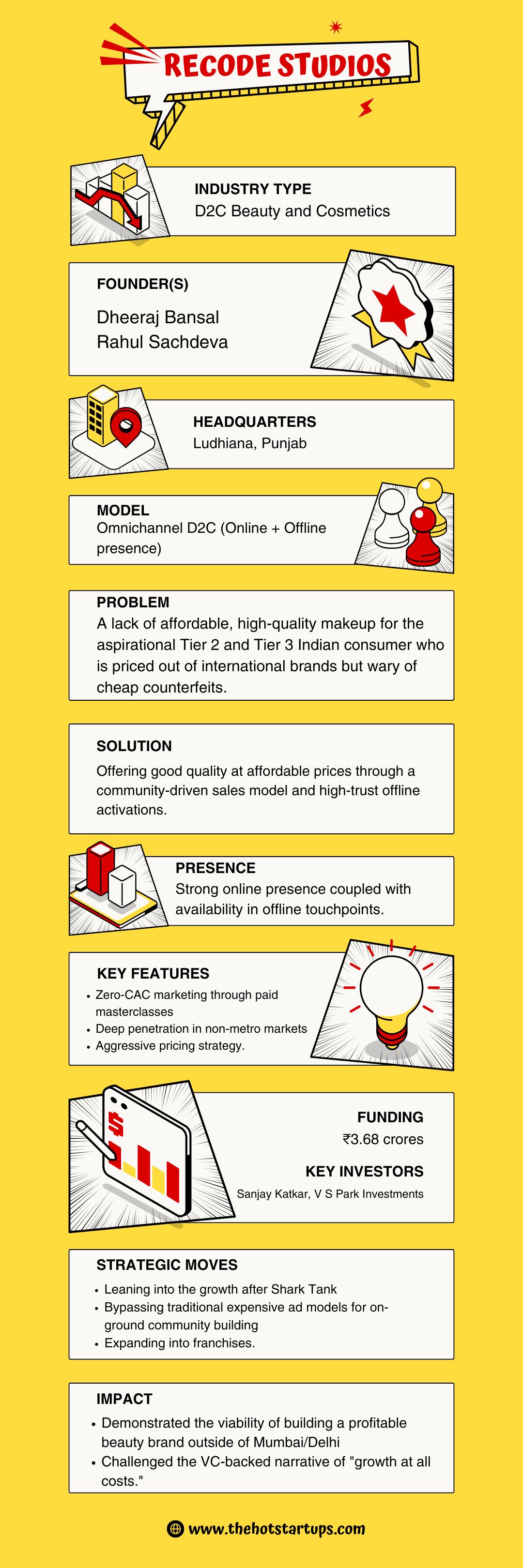
Let’s look at their start-up journey!

Some of our recent stories:
Can you challenge Colgate?
(Perfora says YES)K L Rahul and Katrin Kaif’s bet on wellness
(HyugaLife’s startup journey of building consumer trust)On Getting Selected by Gully Boy
(Urban Monkey’s No VC Startup Journey)
THE INITIAL YEARS
Recode Studios came from an unlikely partnership between a bicycle parts manufacturer and a cosmetics industry veteran. They knew each other through family ties and their skills were complementary.
They partnered with established manufacturers in Germany, Taiwan, and Thailand to maintain product quality, ensuring formulations met international standards, then priced them for Indian purchasing power.
Initially, they had limited SKUs, including eyeliner, lipsticks, and nail polish. The growth was steady unspectacular by startup standards.
Their revenue for 2018-19 was ₹25 Lakhs.
During Covid, when orders fumbled, they liquidated their products for ₹1 each. This asymmetric pricing helped them majorly in generating word-of-mouth.
After that, their revenue surged:
₹2 crores in 2019-20
₹5 crores in 2020-21
₹15 crores in 2021-22
₹22.5 crores in 2022-23
₹37.2 crores in 2023-24
As of 2024, they also had a ~40% repeat order rate.
Sometimes, the opportunity is in removing the barrier between desire and purchase.
THE REVERSE PLAYBOOK
In February 2023 - five years after founding, already at ₹22.5 crore revenue - they raised their first and only external funding: ₹3.68 crore in seed capital.
Compare this to the broader Indian D2C beauty landscape. Sugar Cosmetics and MyGlamm raised significant venture capital. Mamaearth became a unicorn before its IPO. The standard playbook in beauty is: raise big, burn on influencer marketing and paid ads, scale fast, worry about unit economics later.
Recode inverted this. They achieved product-market fit and distribution before taking outside capital.
THE ZERO-CAC MASTERCLASS
D2C is notorious for Customer Acquisition Cost (CAC). The standard playbook involves burning mountains of venture capital on Facebook and Google ads to acquire customers, hoping their lifetime value eventually outweighs the initial ad spend.
Recode Studios, largely out of necessity due to their bootstrapped nature, developed a brilliant alternative: they monetized their marketing funnel (Peyush Bansal was especially impressed with this on Shark Tank).
Their primary customer acquisition vehicle is the offline makeup masterclass, hosted in 5-star hotels across Tier 2 cities. They invite local makeup artists and enthusiasts for a full-day workshop.
They charge participants approximately ₹1,500 to attend. That fee covers the cost of the hotel venue and lunch. In return, each participant receives ₹1,500 worth of Recode products, effectively making the class "free" for the attendee.
For Recode, this translates to a Customer Acquisition Cost of zero by deeply immersing them in the brand ecosystem, demonstrating product quality live, and generating immediate sales volume.
It turns a marketing expense line item into a break-even activity that builds immense community trust. This high-touch, offline strategy is incredibly difficult for purely digital competitors to replicate at scale.
Innovative business models find ways to make the customer acquisition process self-liquidating. If you can provide enough value (like education or community) in the marketing phase that people are willing to pay for it, your growth engine becomes infinitely sustainable.
THE FRANCHISE GAMBIT
By 2023, Recode had proven the model online. Now they needed physical presence without the capital expenditure of company-owned stores. Their answer: FOFO - Franchise Owned, Franchise Operated.
Each franchise requires ₹20 lakhs investment from the franchisee. Recode provides brand, inventory, training, and operational support. The franchisee owns the store and keeps the margin.
This is asset-light expansion at its finest. Recode gets distribution without burning capital on real estate and store operations. Franchisees get a proven brand and supply chain.
They've also added a marketplace layer. Third-party beauty brands now account for 25% of revenue, with Recode earning 30% commission on those sales. This diversifies revenue and makes Recode a destination for beauty shopping, not just a single brand.
COMPETITIVE LANDSCAPE
The elephant in the room for Recode is, naturally, Sugar Cosmetics. The comparison is stark and illustrative of two different ways to build a company in India.
Sugar is a classic VC success story, raising $96.3M to fuel aggressive branding, high-profile celebrity endorsements, and rapid retail expansion. They are the sleek, metro-focused incumbent.
Recode is the foil. Until very recently, they were entirely bootstrapped, growing only on profits re-invested into the business.
Other competitors like Mamaearth (Honasa Consumer) operate on a "house of brands" model, launching rapid-fire product lines, while legacy players like Lakmé rely on generational name recognition.
Recode’s competitive moat isn't capital; it is their deep entrenchment in the offline networks of "Bharat" and the fierce loyalty generated by their origin story.
Your competitive advantage doesn't always have to be a better product feature. Sometimes, your advantage is your capital structure. Being bootstrapped forces discipline and creative problem-solving that well-funded competitors, reliant on paid ads, often overlook.
CONCLUSION:
The Indian beauty market needs more companies that understand the gap between aspiration and affordability, and build businesses that bridge it without requiring hundreds of millions in venture capital to survive.
Recode demonstrates a shift away from the "growth at all costs" mentality that dominated the previous decade, moving toward sustainable, profitable unit economics.
Their success validates the immense purchasing power outside of India's top six metros, proving that Tier 2 and 3 consumers demand quality and will pay for it if the value proposition is right.
In the end, the Sharks didn't invest in Recode, but the audience did, and that proved to be the far more lucrative deal.
Key Insights:
Bootstrap First:
Growing to meaningful revenue before raising capital gives you leverage, control, and better unit economics.Crisis Conversion:
Moving fast during disruption and converting viral attention into lasting customers separates survivors from casualties.Asset-Light Scaling:
Franchise models expand distribution without burning capital, though you trade speed for consistency and control.Execution Over Story:
In commoditized markets, delivering good products at fair prices with reliable distribution beats elaborate brand mythology.Patience Pays:
Playing the long game with profitability focus can win against venture-backed competitors optimizing for growth theater.

Reply