- The Hot Startups
- Posts
- Urban Monkey Startup Journey: Bootstrapping Streetwear in India
Urban Monkey Startup Journey: Bootstrapping Streetwear in India
Building a culturally relevant lasting brand without VC money

Dhara Mandaliya
January 06, 2026 • Reading Time: 5 minutes
Yash Gangwal had spent his childhood skateboarding on Hong Kong's gritty streets before moving back to India at 24, recognized something crucial: streetwear is about belonging to a sub-culture.
India also had a massive underground rap community, but at that time, no brand was actively focusing on streetwear for them.
That insight would power Urban Monkey to a brand moving 50,000+ products annually as of 2022, with celebrity collaborations from Raftaar to Divine. In late 2025, they also inaugurated the first flagship store in Mumbai.
But the journey from making caps for skaters to appearing on Shark Tank India with a ₹100 crore valuation taught Gangwal that you can't manufacture community. You can only serve one that already exists.
Here’s everything you need to know about the startup Prasuma Momos at a glance:
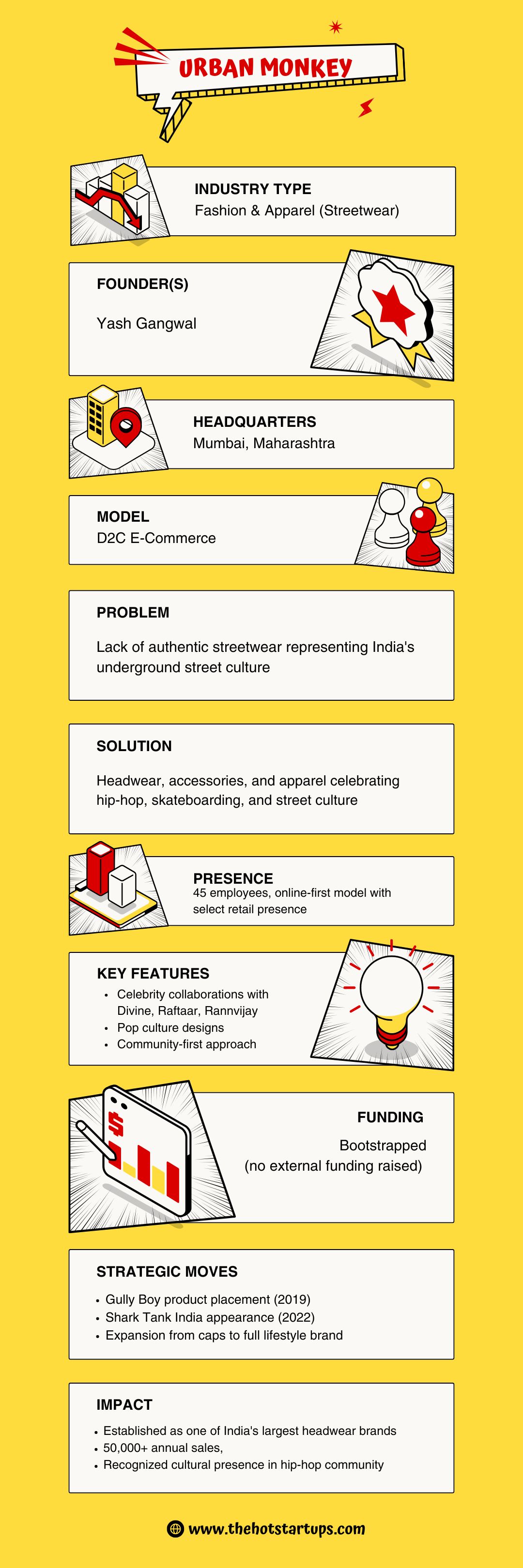
Let’s look at their start-up journey!

Some of our recent stories:
Giva’s bet on silver jewellery
(lessons from India’s fastest growing D2C jewellery brand)How Prasuma created India’s first frozen momos
(and ₹131 Cr ITC acquisition)Building a ₹167 Cr Sneaker brand in 2 years
(The success of Comet Shoes)
The Underground Rises
India's streetwear market is projected to cross ₹8 billion by 2025, growing at over 10 percent annually since 2021. This wasn't always the case. Back in 2014, when Gangwal founded Urban Monkey, streetwear existed in India's cultural margins alongside skateboarding and underground rap.
The mainstream fashion conversation revolved around ethnic wear, formal attire, or Western fast fashion from international brands. Nobody was building for the kids who idolized Eminem and wore snapbacks to rap battles.
Gangwal understood street culture's visual language viscerally. When he returned to India and joined Mumbai's skateboarding community through a Facebook group called Skateboarding in Mumbai, he found his tribe.
The initial product line was focused on caps and skateboards - just the essentials that the community actually needed.
Build for the smallest viable community first. Urban Monkey started with skaters and rappers in Mumbai - not 'youth in India.' Tight community focus lets you actually solve real problems instead of guessing at market segments.
When Bollywood Called
In 2016, Urban Monkey began collaborating with Dharavi United, turning into a campaign called #MakeIndiaGreatAgain by providing products to young artists in Mumbai's largest slum. Gangwal genuinely wanted to support the underground community that inspired his brand.
What he didn't anticipate was how this grassroots presence would position Urban Monkey at exactly the right place when Zoya Akhtar started casting for Gully Boy. The film's costume department dressed characters in the brand's caps and accessories throughout the movie. The wardrobe team simply recognized Urban Monkey as the authentic choice for characters representing Mumbai's hip-hop underground.
Cultural credibility can't be manufactured through marketing spend. Urban Monkey spent three years supporting underground artists before Gully Boy. When mainstream attention came, the community vouched for them. Build legitimacy before seeking scale.
The Competitive Landscape
India's D2C streetwear and casual fashion space features several established players, each with distinct strategies.
Bewakoof, founded in 2012, operates at a massive scale and focuses on affordable fandom fashion. They sell graphic tees and hoodies at budget prices (₹399-₹799), appealing to cost-conscious consumers who want trendy designs referencing pop culture and internet memes. Bewakoof has raised external funding and operates across marketplaces like Amazon and Flipkart alongside their own website.
The Souled Store, launched in 2013 by three college friends, has also raised external funding. They hold official licensing deals with Disney, Marvel, Warner Bros, and major sports leagues, positioning themselves as the premium option for official fandom merchandise. Their t-shirts run ₹699-₹1,499, targeting the same 18-30 demographic but with higher disposable income.
There’s also Capsul that offers similar products as Urban Monkey, only with premium pricing. Majorly online with stores in Mumbai and Bangalore, it targets urban youth looking for skate-inspired gear. Similar to Supreme, its strategy majorly focuses on curated drops.
Urban Monkey differentiates through three strategic choices.
First, they've remained bootstrapped while competitors raised venture funding. This forced capital discipline but allowed Gangwal to maintain complete control over brand direction and avoid pressure to compromise on community values for growth metrics.
Second, Urban Monkey specializes in headwear and accessories rather than competing head-on in the oversaturated graphic tee market. Caps account for 40 percent of their business, eyewear another 30 percent - categories where they've built genuine expertise.
Third, and most critically, Urban Monkey cultivates actual relationships with India's hip-hop and skateboarding communities rather than simply licensing IP or following trending memes.
The strategic tradeoff is growth velocity. The Souled Store's licensing deals and funding enabled faster expansion. Bewakoof's marketplace presence and funding rounds allowed them to achieve massive distribution. Urban Monkey grew slower but maintained higher margins (25 percent net profit by FY 2021-22) and authentic community ties that create durable competitive advantages.
Choose your competitive dimension deliberately. Urban Monkey won on authenticity, affordability, and community - advantages that don't require capital, just genuine commitment.
The Capital Challenge
Cash flow management becomes existential when you're bootstrapped. Urban Monkey couldn't afford to hold months of inventory or run aggressive customer acquisition campaigns. They had to sell products before paying manufacturers, which meant working exclusively with suppliers willing to extend credit terms.
The funding question came to a head during their Shark Tank pitch. He had three offers by the time the pitch concluded but no deal happened.
Peyush's condition that Urban Monkey focus solely on caps and eyewear conflicted with Gangwal's vision of building a full lifestyle brand. The entrepreneur chose strategic flexibility over immediate capital.
The Shark Tank appearance provided massive visibility even without a deal - exactly what entrepreneurs hope for when they appear on the show.
The bootstrapped approach also meant Urban Monkey couldn't follow The Souled Store's strategy of signing expensive licensing deals with Disney or Marvel. They couldn't afford VegNonVeg's strategy of opening premium retail stores in upscale neighborhoods. They had to build slowly, reinvesting profits into inventory and limited marketing spend.
Capital is more than just growth speed - it's about strategic options. Bootstrapping forced Urban Monkey into organic community building because they couldn't afford paid acquisition. Sometimes constraints create competitive advantages, but recognize what doors they close.
Manufacturing and Operations
Urban Monkey's operational model reflects the realities of bootstrapped fashion businesses in India. They don't own factories or warehouses. Instead, they work with third-party manufacturers across India, China, USA, and Burkina Faso, selecting partners based on product category expertise.
This asset-light approach minimizes capital requirements but creates quality control challenges. Urban Monkey addresses this through an in-house design and quality assurance team that inspects products before they ship to customers. .
When products sell out, they're often gone until the next production run - creating artificial scarcity that actually enhances brand desirability among streetwear consumers who value exclusivity.
While competitors like Bewakoof and The Souled Store sell across Amazon, Flipkart, Myntra, and other marketplaces, Urban Monkey exited those channels years ago. Gangwal found marketplace fees and unpredictable demand fluctuations hurt profitability. By controlling the entire customer relationship through their website, Urban Monkey captures full margins and owns customer data for remarketing.
This choice limits growth but improves economics. A product sold on Amazon might generate ₹500 in revenue but only ₹300 in profit after marketplace fees and discounting pressure. The same product sold on Urban Monkey's website might generate ₹700 in revenue and ₹500 in profit. Lower volume, higher per-unit economics - the bootstrapped company tradeoff.
The cash-on-delivery challenge represents one of Urban Monkey's most persistent operational headaches, as the founder announced it on LinkedIn. COD orders have significantly higher return rates (20-30 percent versus 5-10 percent for prepaid orders) because customers who haven't paid upfront face no friction in refusing delivery.
Each COD return means Urban Monkey paid for manufacturing, shipping, failed delivery attempts, and return shipping - all for zero revenue. So, they now operate on a fully pre-paid basis.
Conclusion
The cultural acceptance of hip-hop and street culture has moved from underground to mainstream, creating space for homegrown streetwear brands that reflect local culture.
The brand has built real assets: community relationships that took years to cultivate, celebrity associations that provide ongoing cultural credibility, operational capabilities for designing and delivering streetwear products, and a ready customer base. These advantages compound over time if protected.
Gangwal's choice to remain bootstrapped means Urban Monkey can't play the growth-at-all-costs game. But they might become the most profitable, the most authentic, or the most culturally embedded. Those are different victory conditions that require different strategies.
Key Insights:
Start Small
Solve deeply for a small, real community first so you build trust, insight, and organic advocacy before scaling.Earn Culture
Cultural credibility can’t be bought - it’s built through long-term, genuine participation in the community.Bootstrap Discipline
Bootstrapping forces sharper decisions that often create stronger, more defensible businesses.Pick Your Edge
Win on one clear dimension you can dominate instead of spreading resources thin trying to compete everywhere.Expand Carefully
Each new category adds hidden complexity, so only expand where your core strengths truly carry over.

Reply