- The Hot Startups
- Posts
- HyugaLife Startup Business Case Study | Katrina Kaif and K L Rahul's Bet on Wellness
HyugaLife Startup Business Case Study | Katrina Kaif and K L Rahul's Bet on Wellness
The Fight Against Fake Supplements in India

Dhara Mandaliya
January 09, 2026 • Reading Time: 5 minutes
The Indian supplement market had a dirty secret everyone knew but few addressed head-on.
The market was flooded with counterfeits containing everything from cheap fillers to dangerous heavy metals. Despite this, India's dietary supplements market was projected to grow at a CAGR of 8.1% from 2025-2030. Someone was going to capture that growth by solving the authenticity crisis.
Sachin Parikh had spent years at Nykaa watching India's beauty market transform from a counterfeit-riddled mess into a trusted e-commerce category. He'd spotted a nearly identical pattern emerging in India's wellness sector.
Except this time, the stakes were higher. Fake lipstick might ruin your evening. Fake whey protein could damage your kidneys.
Anvi Shah, who'd navigated supply chain complexity at Unilever and Amazon, and Neehar Modi, an Amazon product management veteran with an Oxford MBA and chemical engineering background also joined forces.
Here’s everything you need to know about the startup HyugaLife at a glance:
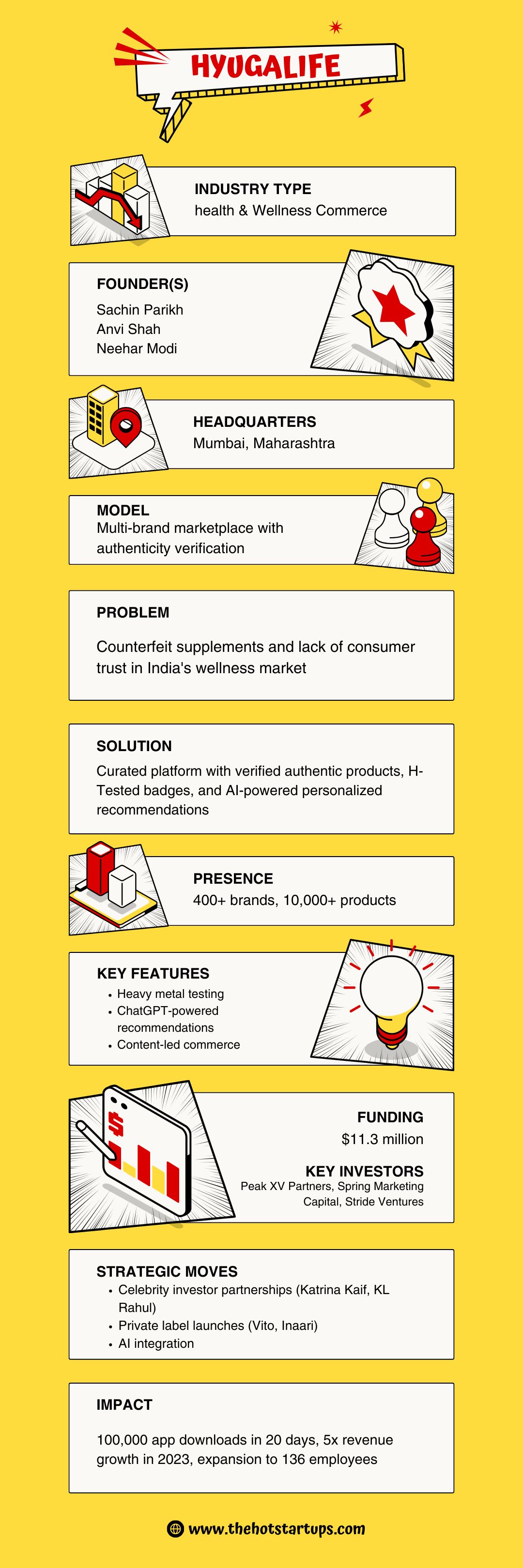
Let’s look at their start-up journey!

Some of our recent stories:
On Getting Selected by Gully Boy
(Urban Monkey’s No VC Startup Journey)Giva’s bet on silver jewellery
(lessons from India’s fastest growing D2C jewellery brand)How Prasuma created India’s first frozen momos
(and ₹131 Cr ITC acquisition)
The Problem:
Post-pandemic health consciousness had created massive demand, but supply hadn't evolved to meet it responsibly. The industry operated on a broken model: over a thousand brands competed on price, distributors cut corners to maintain margins, and consumers had no reliable way to verify authenticity. Women increasingly dealt with hormonal imbalances like PCOS, yet specialized supplements for female health barely existed. Gym-goers spent thousands on supplements they couldn't verify weren't counterfeit.
The founders saw what Nykaa had proven in beauty: Indian consumers would pay premium prices for guaranteed authenticity if someone credible vouched for it. But wellness had additional complexity.
The moat wouldn't come from having more inventory - HealthKart already dominated with established supply chains. It would come from being the only platform consumers actually trusted.
The Solution:
HyugaLife launched in April 2022 under parent company Pratech Brands with a $3 million seed round led by Sequoia India's Surge. From day one, the positioning was deliberate: this was India's first wellness platform where every product carried verification you could trust.
The product strategy had three layers:
First, direct sourcing from 300+ brands with stringent verification at every step.
Second, transparency initiatives like the H-Tested and Heavy Metal Tested badges endorsed by KL Rahul, turning quality assurance into a consumer-facing brand.
Third, AI-powered personalization through a ChatGPT-driven chat feature that provided tailored wellness recommendations. This combination created something new: you weren't just buying supplements, you were accessing a personalized wellness advisor that learned from your behavior.
The app launched in 2023 with immediate traction - 1,00,000 downloads in under 20 days.
They also made an early bet on private labels. While the marketplace generated volume, owned brands like Vito (targeting busy millennials with sleep, immune, and bone health supplements) and Inaari (women's hormonal wellness) carried higher margins and deeper consumer relationships.
This mirrored Nykaa's playbook: use third-party brands for traffic, use owned brands for profitability. Within their first year, they'd invested Rs 4 crore in Inaari alone, signaling serious conviction in the women's wellness category.
Marketplaces are great for distribution. Brands are how you capture value. The mistake most Indian D2C founders make is picking one strategy and dying on that hill. Smart operators do both simultaneously.
Initial Challenges:
Pratech Brands' revenue surged from Rs 1.71 lakh in FY22 to Rs 4.87 crore in FY23 - a mind-bending increase. On the flip side: losses exploded from Rs 99 lakh to Rs 25.39 crore.
Customer acquisition costs in wellness are brutal. To stand out, HyugaLife spent heavily on celebrity partnerships, technology infrastructure, content creation, and verification processes. Every rupee of trust they built cost money. The question haunting their boardroom: would consumers pay enough premium to justify these costs?
The team’s content-led efforts aimed to reduce CAC through SEO and educational content that brought customers organically. But executing this strategy required burning cash upfront to build the infrastructure.
Another challenge lurked in the background: employee count. HyugaLife had to cut employee count to 136 employees by July 2025, 19% lower than the previous year.
That signals either a strategic pivot or pressure to extend the runway. For a company at their stage, every month of burn matters intensely when you're racing to prove unit economics.
Also Read: Building a brand like Nykaa
Competition:
HyugaLife operates in arguably India's most competitive wellness battlefield. HealthKart dominates with $350.91 million in funding, owned brands like MuscleBlaze, and partnerships with giants like Karnataka Milk Federation for specialized whey production.
HealthKart saw HyugaLife's authenticity play and responded by partnering with KMF for whey production with complete supply chain transparency. They matched the celebrity game by partnering with influencers at scale through platforms like KlugKlug.

They even emphasized their own quality testing. When an incumbent with 20x your revenue adopts your strategy, that's simultaneously validation and threat.
Then there's Nutrabay with $5 million in Series A funding, Wellcurve building share, and category-adjacent threats like Tata 1mg and PharmEasy who could easily expand into wellness.
HyugaLife’s organisational size lends it agility, which only matters if you survive long enough to exploit it. The race is about execution speed versus capital efficiency.
Funding and Revenue:
HyugaLife's $11.3 million total funding across four rounds tells a story about investor confidence - and investor caution.
The cap table reads like a who's who of smart money: Peak XV Partners (Surge), Spring Marketing Capital (backed by Godrej Consumer Products), Stride Ventures providing debt financing. Angel investors include Arihant Patni and notable individuals like Dhaval Parikh. Katrina Kaif and KL Rahul invested undisclosed amounts, but their involvement goes beyond capital - it's strategic brand equity.
The January 2024 round that brought in $6.3 million was particularly telling. Spring Marketing Capital and Stride Ventures led with investments of Rs 12.5 crore and Rs 15.5 crore respectively. This was a bet on defensibility: investors saw the technology moat (AI recommendations), the trust infrastructure (verification badges), and the celebrity flywheel (Kaif and Rahul driving organic awareness). Post-funding, promoters retained 52% ownership, with Surge holding 18.6% and Spring at 9.4%.
Venture capitalists are patient with negative unit economics if they see a path to profitability. The implicit bet here is that HyugaLife reaches a scale where technology investments already made continue driving recommendations without incremental cost and where private label margins improve overall economics.
Debt financing signals investor belief in near-term cash flow stability - you only lend to companies you trust will generate revenue to service debt. It also suggests founders wanted to minimize dilution, betting their own equity would be worth more as they proved the model. That's either confidence or necessity, depending on whether Series A terms were attractive enough to warrant equity dilution.
Revenue growth remains the bright spot: jumping from ₹ 4.87 crores in FY 23 crore to ₹32.2 crores in FY 24. That might make investors overlook profitability concerns. If HyugaLife maintains even half that growth rate while improving margins through private labels and operational leverage, the path to profitability emerges.
Conclusion:
HyugaLife's future hinges on three critical execution areas.
First, unit economics must improve dramatically. They need to either increase average order value through bundles and subscriptions, reduce customer acquisition costs through organic channels, or improve margins through private label penetration. Ideally all three
Second, they must differentiate further from HealthKart before the incumbent fully adapts. These capabilities are defensible because they require different organizational DNA than traditional retail operations. But they only create lasting advantage if HyugaLife moves fast enough.
Third, they need to nail retention economics. Their business model only works if customers return repeatedly. Monthly subscriptions for supplements with 10% discounts could dramatically improve lifetime value while providing predictable cash flow.
In contrast to Nykaa’s beauty products, wellness products are not functional purchases driven by efficacy. The willingness to pay a premium narrows when consumers can't see or feel immediate results.
Key Insights:
Pedigree Leverage
Relevant operator experience opens doors faster, so use it aggressively or borrow credibility through co-founders and advisors.Aligned Celebrities
Celebrity partnerships only compound when they have equity, not just contracts, because ownership changes behavior.Trust Moat
In commoditized categories, defensible advantage comes from consumer trust systems, not sourcing or distribution alone.Economic Reality
Scale doesn’t fix broken unit economics, so model profitability honestly before growth multiplies losses.Market Timing
Strong structural tailwinds can mask execution flaws, but no amount of execution saves bad timing.

Reply